The Glass Menagerie
The Glass MenagerieThe Glass Menagerie is the collection of glass animals in the Wingfield apartment and the play’s central material emblem of Laura’s inward life and Tom’s enduring memory of her. First arranged in the living room as a collection of transparent ornaments, it becomes something more than decoration: Amanda invokes it when imagining a future without security, Laura explains it to Jim with shy pride, and the broken horn of its unicorn turns a moment of intimacy into an image of fragility and accommodation. In Tom’s final speech, colored glass resurfaces in a shop window as a vivid reminder that he has not managed to leave his sister behind.
The Collection in the Wingfield Apartment
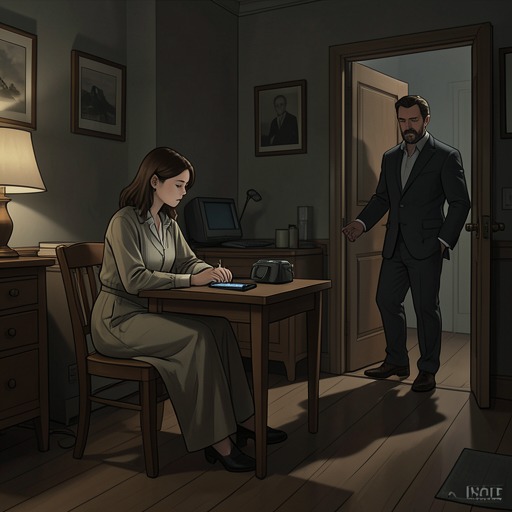
The animals occupy an old-fashioned whatnot in the living room, the room that also serves as Laura’s sleeping space; the sofa unfolds to make her bed. Their transparent bodies sit amid a set whose visual language is already shaped by memory: the interior is dim and poetic, and objects take on an importance proportionate to the emotion attached to them. The glass is thus introduced not as an inventory item alone, but as part of the remembered apartment’s charged arrangement of domestic things.
The stage places the collection near other traces of family history and abandoned prospects. A large photograph of the father hangs beside the archway, while a typewriter keyboard chart and Gregg shorthand diagram remain above the typewriter. The animals share the living room with these reminders, but their delicacy gives them a distinct presence: they are tangible, carefully kept objects in a household marked by an absent father and Laura’s withdrawal from a business career.
Tom’s account establishes the collection’s place in the play’s form. He describes the drama as memory, a dim, sentimental, nonrealistic world in which music accompanies events and images carry emotional weight. The collection is therefore both a household possession and a theatrical motif: it belongs to Laura’s room, yet it also supplies the play with a recurring visual language for vulnerability and recollection.
Laura’s Attachment and Amanda’s Fear of the Future
Amanda turns the collection into part of a bleak argument about the family’s prospects. After Laura has said she could not face her business course, Amanda wonders whether they will spend their lives at home watching parades go by, amusing themselves with the glass animals, and playing the worn-out records left by their father. The sequence places the collection beside two other forms of retreat—passive observation and inherited music—while Amanda’s central fear is financial and social dependence.
She imagines unmarried women without a position living on reluctant help from relatives, confined to small rooms and passed between in-laws. Her image of little birdlike women without a nest ends in a life spent eating the crust of humility. The collection is not the cause of that future, but Amanda’s appeal to it makes it a sign of the circumscribed life she fears for both of them: an inward amusement cannot, by itself, provide a livelihood or a secure place in the world.
The image returns when Amanda reappears and is astonished that Laura has no gentleman callers. Laura slips through the half-open portieres, nervously echoes her mother’s laugh, and draws the curtains behind her as a shaft of clear light falls across her face. The music associated with The Glass Menagerie sounds faintly while Amanda continues to press the contrast between her own popularity in Blue Mountain and Laura’s isolation. The glass is not handled in this moment, but its music accompanies Laura’s retreat, tying the collection to the private, vulnerable world the social conversation cannot reach.
Showing the Animals to Jim
When Jim asks what kind of glass Laura means, she explains that the objects are mostly ornaments, little animals, and the tiniest glass animals in the world. She says that Amanda calls them a glass menagerie and offers him one as an example, identifying it as one of the oldest and nearly thirteen. The exchange gives Laura a moment of quiet authority: she can describe the collection, choose a piece to show, and invite Jim into an interest she usually keeps within the apartment.
The introduction remains modest rather than grand. Laura calls the animals little articles and ornaments, yet her specific description distinguishes them from ordinary household clutter. The collection gives her a subject she can share without having to perform the confidence Amanda expects of her in social life. Jim’s attention makes the objects part of a conversation between them, while the music associated with the collection marks the scene as emotionally charged within Tom’s memory-play structure.
The Unicorn’s Broken Horn
During a dance, Laura and Jim suddenly bump into the table, and the glass piece on it falls to the floor. Jim stops dancing and asks what they hit; Laura answers that it was the table. The brief accident brings the collection’s fragility out of the background and into the action. A piece that had been presented carefully to a visitor is now damaged through an unintended collision between the two people in the room.
Laura identifies the missing part as the unicorn’s horn and tells Jim it does not matter; perhaps it is a blessing in disguise. When he worries that it was her favorite and says he was the cause, she answers that she does not have favorites much and that glass breaks easily, however careful one is: traffic jars the shelves and things fall off. Her explanation gives the accident a wider, familiar context. The break is not only a single mishap; it belongs to the everyday instability of objects on shelves in a building where passing traffic can shake them loose.
Laura then imagines that the unicorn had an operation to remove its horn, so it will feel less freakish and more at home with the other horses. The joke makes the altered object seem newly included rather than simply ruined. It also turns a break into a small act of reinterpretation: Laura does not deny the damage, but gives it a consoling explanation. In a scene where the glass’s material vulnerability is suddenly unmistakable, the unicorn’s difference is reduced, and its place among the ordinary horses becomes easier to imagine.
The Collection After Tom’s Departure
In his closing speech, Tom says that he left St. Louis and descended the fire escape for the last time, following his father’s footsteps and trying through movement to recover what had been lost in space. He recalls traveling from city to city, with the cities sweeping around him like brightly colored leaves torn from their branches. His motion has not ended the past: he says something pursued him and could arrive unexpectedly, perhaps as familiar music or as a piece of transparent glass.
The image becomes concrete in a shop window filled with colored glass, tiny transparent bottles in delicate colors like pieces of a shattered rainbow. At that sight, Tom’s sister touches his shoulder in memory, and he turns to look into her eyes. He admits that he tried to leave Laura behind but was more faithful than he intended to be. The glass is no longer merely an ornament in the apartment; its transparent, colored forms have become part of the world through which his guilt and remembrance return.
Tom’s efforts to escape the memory are expressed as a sequence of actions: reaching for a cigarette, crossing the street, running into a movie theater or a bar, buying a drink, or speaking to the nearest stranger. He says he will do anything to blow out Laura’s candles. The collection’s fragile transparency thus returns in a transformed setting, joined to the candle image and the final goodbye. What Laura once kept in the apartment has become for Tom an image that travels with him, and the play ends not with successful forgetting but with his admission that departure has not severed his attachment.